How High School Journalists Helped Uncover Embezzlers

We were somewhat conflicted about whether to report a story that seemed sketchy when we had so little time to gather information.

Rebekah Rombom, Co-Editor, The Hilltop Beacon

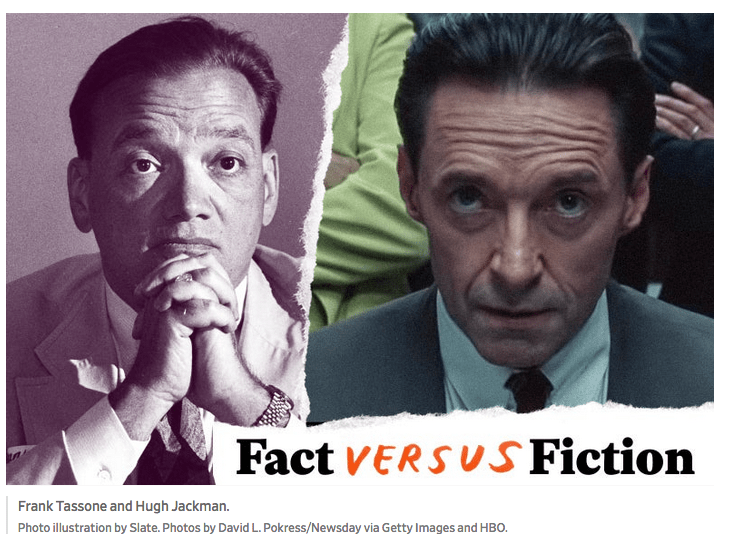
Here is more information on the HBO film, Bad Education, which I referenced on our Zoom meeting this morning. To be sure, it is a fictionalized account of what happened in the Roslyn School District in Nassau County, just north of New York City from 2002 to 2004.

The reason I bring this to your attention is because reporters at the high school newspaper, The Hilltop Beacon, broke the story, which eventually led to criminal charges against both the superintendent and assistant superintendent of the Roslyn School District. More than $11 million dollars of tax-payer dollars had been embezzled.

In a New York Times article, one of the student reporters talks about how nervous they were to proceed with the story, which they’d been tipped off on.

“We were somewhat conflicted about whether to report a story that seemed sketchy when we had so little time to gather information. Writers for the Beacon often complained that it was difficult to schedule interviews with administrators on short notice,” according to the co-editor of The Hilltop Beacon. “Our adviser’s advice was simple: we were a newspaper, he told us, and it was our responsibility to report the news. We decided to do just that. This was big news, and no media outlet had reported the story. I then volunteered to write the article.”

Here’s an article on Slate that shows how closely the movie followed the true-to-life events. It is interesting to note that the screenwriter of this film, Michael Makowsky was a middle school student when the school superintendent, Frank Tassone was charged. Check out the Vanity Fair article here. One thing that bothered me: Tassone was released from prison in 2010, yet the screenwriter never reached out to the now, former felon. Wonder why?

After the school newspaper broke the story, Newsday and New York Magazine, among others, published in-depth stories on the scandal. The Bad Superintendent, written by Robert Kolker for New York Magazine is what the film version is based upon.

I believe HBO is free this month? If you have it, watch it! It will inspire you! I welcome comments on this!
Where Investigative Reporting and Data Analysis Meet

I read this story in the Washington Post just now on the 18,000 false or misleading claims made by President Trump in 1,170 days and I wanted to share it with you.

This is not to suggest that elected officials of all stripes don’t bend the facts as they see fit from time-to-time  to make themselves look better. I would submit, however, that this President’s history of bald-faced lies is, to use a word that’s being tossed around a million times a day, unprecedented.

President Trump made 18,000 false or misleading claims in 1,170 days

This in-depth examination of truth versus lies illustrates some very cool trends in digital news reporting.  I want to draw your attention to the videos in this story and the jobs that go along with producing this content: fact checkers, graphic artists, video editors —along with researchers, editors, photographers, animators—a whole host of jobs that exist in what once was a “traditional” newsroom. If you click on the link that takes you to the “jump page” “The false claims Trump keeps repeating,” note the way the interactive graphic works. Consider the art work that went behind creating that graphic.

I think this should make us excited about the way journalism is evolving. To be sure, jobs are on the decline and we don’t know how this health crisis and the accompanying economic downfall will yield permanent change, but we do know the need for truthful reporting has never been more important.

You can earn five extra-credit points if you comment on this story, or reply to a classmate’s thoughts. Comment period closes April 19th at midnight. Get ’em while you can. 

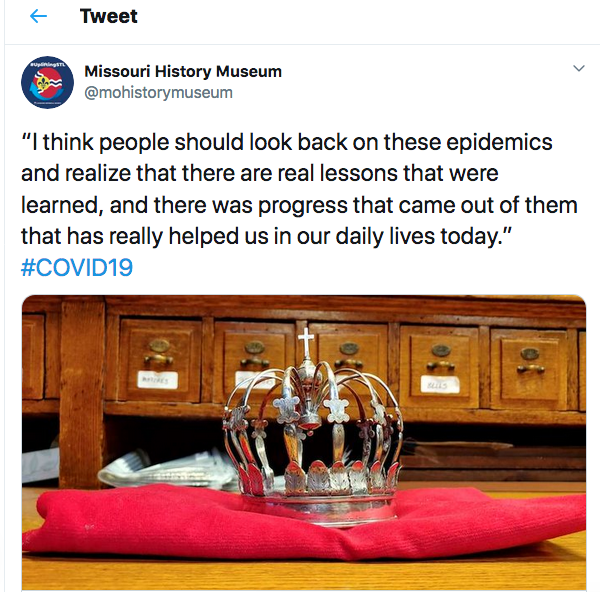
A sickness and a silver crown: How Saint Louis University survived the cholera epidemic of 1849

I came upon this story about SLU and the cholera epidemic of 1849 on Twitter and found it quite inspirational. Maybe you will too. Here’s the link to the story embedded in the tweet. While we all know that there are controversial chapters in SLU’s history, (I’m thinking slavery in particular) other historical gems like this remind us that we’re in a learning community that’s survived and thrived for more than 200 years now.

Local News, Another Casualty of Covid-19

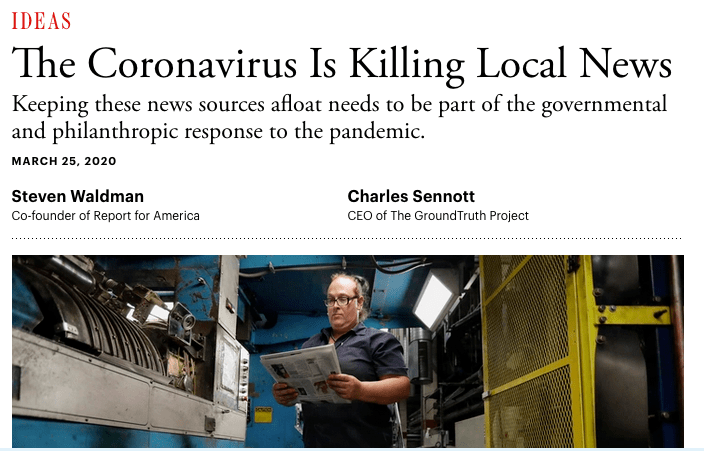
Here’s a thought provoking article in The Atlantic.

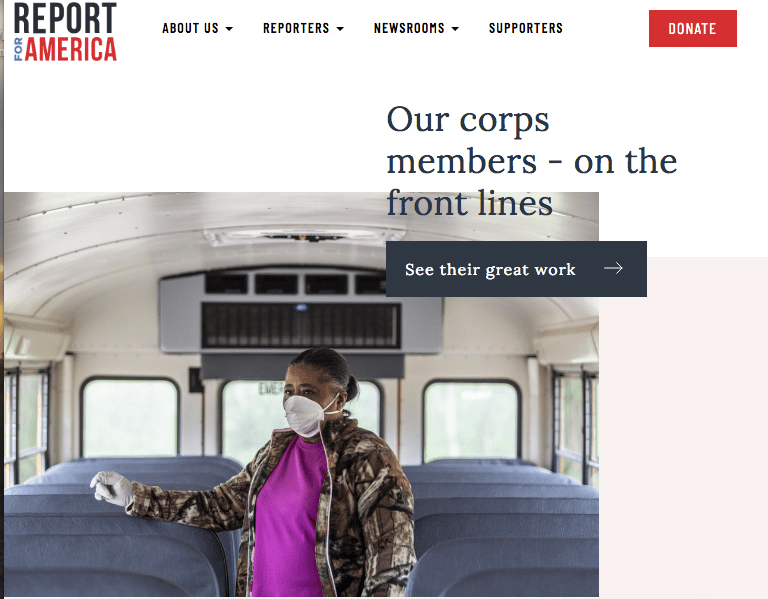
It is co-authored by Steve Waldman, Co-Founder of Report for America and Charles Sennott, CEO of The GroundTruth Project. The story deals with the economic impact of the pandemic on local newspapers and it’s worth a read.

Our original syllabus called for us to discuss job prospects for journalists at the end of the semester. Much of what I had planned to discuss with you, now is temporarily upended. Let’s hold a good thought that programs like Report for America will find their way to additional funding sources, because the need for local reporting is more important now than ever before.

Gee, wish Bloomberg hadn’t spent all that money on a failed presidential bid, he could completely fund a program like this. Meantime, I’ll donate $10 to Report for America and $3 for a digital subscription to the St. Louis Post-Dispatch.

Case Study: From Press Release to Lead Story

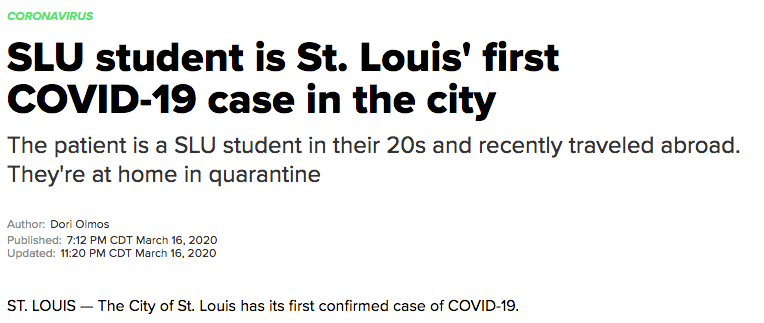
SLU at the center of the St. Louis Coronavirus outbreak

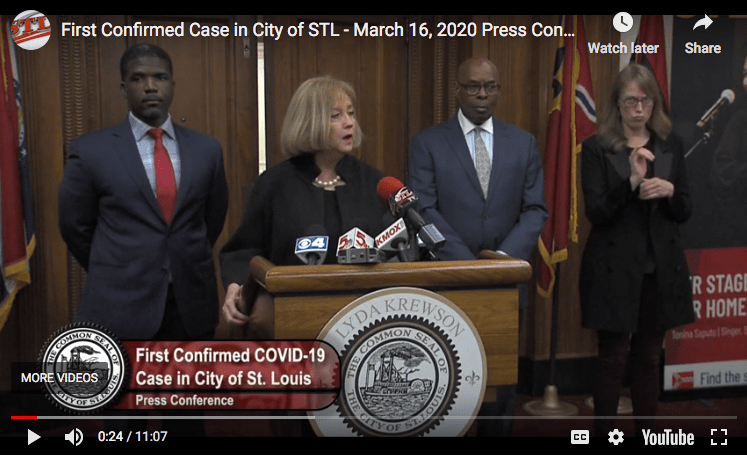
It’s a news event to which no university wants to be attached: having one of their students be the first person in a major metropolitan area to test positive for a highly-contagious virus that is sweeping the globe. Yet, that was the precise situation Saint Louis University found itself in on Monday, March 16.

Within minutes, after the mayor’s news conference, the story was on every major news outlet in Missouri and beyond, reporting that the first positive case involved a student at SLU. Yet, at no time in this press briefing did Mayor Lyda Krewson nor St. Louis Director of Health, Dr. Fredrick Echolsd disclose that fact.

A half-hour after the first stories surfaced in the media, (the one above appearing on the local NBC affiliate’s website) the office of President Fred Pestello dispatched an internal email notifying the SLU community that the first case of Covid 19 in indeed, “one of our own.”

“Tonight, I share that one of those students has tested positive.”

The posting on the KSDK website would be the first of many stories posted or broadcast about the first confirmed case and the blast email from Dr. Pestello would be the first of many updates over coming days to keep the greater SLU community informed.

This dramatic and certainly unnerving situation provides a textbook example of how public/media relations people work with the media, and in this case, public officials who end up being the conduits of that information. Isn’t it interesting that nobody from the mayor’s office revealed that it was a SLU student. Why do you think they were so protective of that information? Isn’t it also interesting that the headline saying the infected person attends school at SLU was published before any information was provided to people’s who proximity to the situation might have warranted them being notified sooner?

In the KSDK story, we can ascertain that a press release probably went out to local media shortly after government and health officials were informed.

A statement from Saint Louis University said the patient is a student of the university who lives off-campus.

The statement from SLU said a second student returned from the same trip and was not showing symptoms but has also been tested. The results from that test are pending.

Given what we’ve recently studied regarding the relationship between public/media relations people and journalists, what do you think about the information flow around this story? Recall that there are internal and external audiences. How were both of those audiences served? Does seeing an unnerving story like this being played out so close to home change your perspective on how public relations and the media work together? Watch the entire press conference. Any thoughts on the way the facts were presented? What about the questions from the reporters? Do you feel they’re fair questions or too aggressive? Post your comment below. No more than a paragraph, two short paragraphs at the most.

Integrated Media or Convergence

As we have seen and talked about this semester, print and broadcast media have converged —meaning that they no longer distribute news on one platform or another. Increasingly, national media outlets such as the New York Times, Washington Post, the Wall Street Journal, VICE Media and many others, utilize video to recap or in many instances, present news in a different fashion.

Take a look at the “fact-checker” video here from the Washington Post on March 12th. It’s a good example of integrated news reporting. In this case, it’s analysis of President Trump’s address to the nation on Wednesday.

https://www.washingtonpost.com/politics/2020/03/12/fact-checking-trumps-address-nation-cornavirus/

What’s Wrong With This Story?

Here’s the St. Louis Public Radio story we listened to this morning.

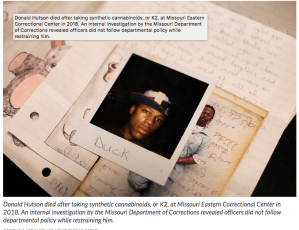
‘Strapped Face-Down’: Questions Linger After Missouri Inmate’s Overdose Death

While most would agree it is tragic, the glaring omission in this story, as Erin pointed out, was this one question: how are these drugs getting into the prison in the first place?

This is a classic example of: 

a) the reporter getting too close to the story, so much so that she overlooked a fundamental question

b) lack of attentive editorial oversight

Don’t assume that your readers/listeners/viewers will already know what’s going on. It is your job to tell them.


Design a site like this with WordPress.com
Get started