SLU at the center of the St. Louis Coronavirus outbreak
It’s a news event to which no university wants to be attached: having one of their students be the first person in a major metropolitan area to test positive for a highly-contagious virus that is sweeping the globe. Yet, that was the precise situation Saint Louis University found itself in on Monday, March 16.
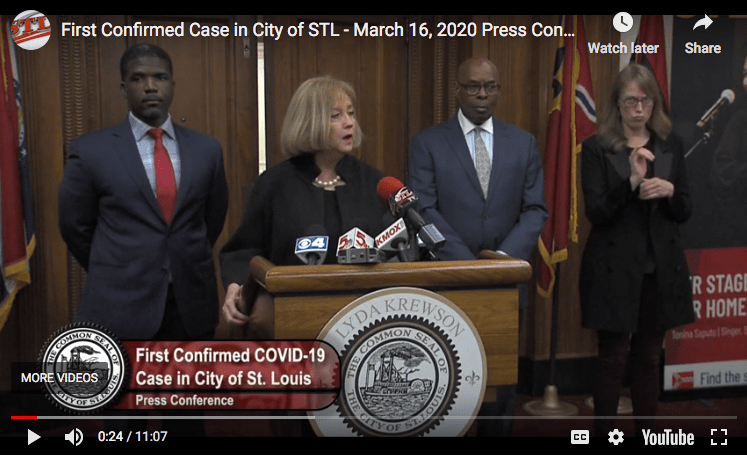
Within minutes, after the mayor’s news conference, the story was on every major news outlet in Missouri and beyond, reporting that the first positive case involved a student at SLU. Yet, at no time in this press briefing did Mayor Lyda Krewson nor St. Louis Director of Health, Dr. Fredrick Echolsd disclose that fact.
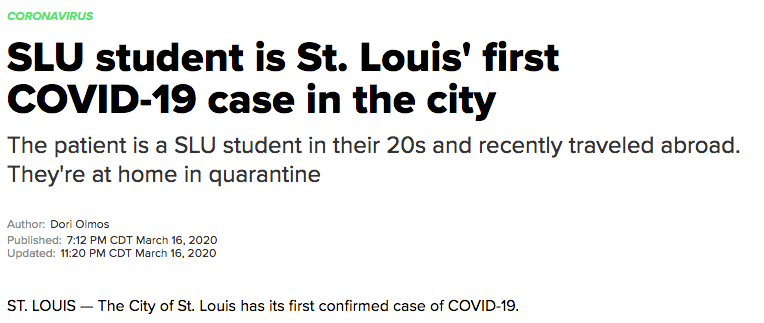
A half-hour after the first stories surfaced in the media, (the one above appearing on the local NBC affiliate’s website) the office of President Fred Pestello dispatched an internal email notifying the SLU community that the first case of Covid 19 in indeed, “one of our own.”
“Tonight, I share that one of those students has tested positive.”
The posting on the KSDK website would be the first of many stories posted or broadcast about the first confirmed case and the blast email from Dr. Pestello would be the first of many updates over coming days to keep the greater SLU community informed.
This dramatic and certainly unnerving situation provides a textbook example of how public/media relations people work with the media, and in this case, public officials who end up being the conduits of that information. Isn’t it interesting that nobody from the mayor’s office revealed that it was a SLU student. Why do you think they were so protective of that information? Isn’t it also interesting that the headline saying the infected person attends school at SLU was published before any information was provided to people’s who proximity to the situation might have warranted them being notified sooner?
In the KSDK story, we can ascertain that a press release probably went out to local media shortly after government and health officials were informed.
A statement from Saint Louis University said the patient is a student of the university who lives off-campus.
The statement from SLU said a second student returned from the same trip and was not showing symptoms but has also been tested. The results from that test are pending.
Given what we’ve recently studied regarding the relationship between public/media relations people and journalists, what do you think about the information flow around this story? Recall that there are internal and external audiences. How were both of those audiences served? Does seeing an unnerving story like this being played out so close to home change your perspective on how public relations and the media work together? Watch the entire press conference. Any thoughts on the way the facts were presented? What about the questions from the reporters? Do you feel they’re fair questions or too aggressive? Post your comment below. No more than a paragraph, two short paragraphs at the most.
 Spring 2020 CMM2100
I thought the word flow around this story was really interesting. I especially thought it was very interesting that the mayor and the medical professionals up there with her were not allowed to disclose anything due to Hippa laws but Hippa does not apply to journalists. One thing I would say is yes, the headline of an SLU student being positive came out before we got an email, but we had been emailed that an SLU student was being tested so it was not a complete letting go of information before the people in close proximity found out. The press conference was just for the external audience because it gave a broad statement about someone being affected. The internal audience was left in the dark by the press release because they left out that it was an SLU student.
I do not believe the journalists were being too harsh with their questions. I believe a majority of the reporters already knew that a student from SLU had been getting a test and I believe they were just trying to see if they could get some more information to confirm that it was the SLU student. You could tell that some of them already knew about the SLU student because one of the reporters asked them if the person with them was staying quarantined. This was not disclosed in the press release but disclosed in the email from Dr. Pastello to the student body. This just made me curious about why the mayor had to follow Hippa laws but SLU and other reporters do not?
LikeLike
Hi Lauren,
Honestly, the mayor and Dr. Echols probably did not have to play “cat-and-mouse” like that with the media, because to your point, it was already widely known that SLU had blasted out an email that two students were being tested. And whether or not the Mar/Com office at SLU sent out a press release to that fact or not is immaterial, because someone undoubtedly leaked it anyway. Point is: most people knew. The mayor and her folks were just being cautious, or some might assert, stonewalling. They didn’t want it to be on THEM to, as I believe she said in the presser, violate HIPPA laws. Regarding the varying degrees of adherence to such, NOBODY released the students’ names, unless I am unaware of some other press reports that might have ID’d them. So in the end, their privacy was protected.
LikeLike
Given what we’ve recently studied regarding the relationship between public/media relations people and journalists, what do you think about the information flow around this story?
I think the flow of the story is interesting in the way some information was delayed to the internal audience of SLU, it makes me curious if there was no information shared by the media if we would have been informed that the case was a SLU student. In this case the external audience was served before the internal. This shows me the importance of the media to share information that some public relations might want to keep quiet, even though it is for the best of the public to be informed.
I thought that the press conference was interesting when the mayor shared the comment “this is all we will be able to disclose at this time” if I was a new reporter in the room I would definitely believe there is more to the story. I thought it was stragetic that they had a medical professional answering questions, it definitely helps calm the community hearing from experts. I thought the questions were aggressive, but I think with the current climate it is okay to be aggressive when the public deserves to know the information.
LikeLike
Hi Kristin, good point on defending what you perceive to be aggressive questioning when there’s a public health crisis. With your interest in pursuing public health (correct me if I’m wrong) this should be of particular interest to you. And I gotta tell ya, if you think THAT’S aggressive, you should be at a press conference when some public official has been outed for a crime or there are raging wildfires or a gunman on the loose…It gets pretty crazy. But that’s what reporters are used to–being given only so much information. It’s often warranted, to protect a legal system, or the privacy of ordinary citizens, or frankly, to tamp down hysteria. What happens 99% of the time though, is reporters do an “end run” around the “talking heads” and get to the facts anyway. Unfortunately, sometimes they get to bad information in the process.
LikeLike
After watching the press conference, I do not think that the reporters’ questions were too aggressive by any means. I think that they were all respectful & were just doing their jobs, by double checking the information that the mayor had just presented them with as well as attempting to get answers to the questions that the public would most likely ask/are critical to the story. I think that in a time such as now, as we are in a situation that is rapidly changing & is cause for fear & uncertainty throughout the country & the world it makes sense that the mayor was reluctant to share some information that may have already been shared by other sources because she does not want her name to be associated with possible wrong information that may have a critical outcome.
As for the difference in timing of the notification of the internal & the external audience, I believe that it is almost impossible to avoid in a situation such as this. Because the student did not physically return to campus, I would argue that there is no more importance for the internal SLU community to be notified as opposed to the external St. Louis community. The internal community is at no more risk than the external in this specific case, which is why I do not feel it to be wrong that there was a delay in notifications. However one thing that I can see being an issue is the question of validity of information, because different sources are releasing different information. If I were a reporter or even just as a member of the general public I would have some concerns as to what information is true.
LikeLike
Hi Kristin, tend to agree with you. In some ways it was political “cover” that influenced the mayor to withhold information. And frankly, as I’ve said in other posts, she knew the info was already out there. Why should she be on the hook for it?
LikeLike
Regarding the relationship between public relations and journalists, I thought that the information flow was working appropriately. The audiences of this story received vital and important information and while I am sure that they would have wished to know more about the person and their whereabouts to ensure that they and their families were safe the city told them that they had not been anywhere public within the city of St. Louis. The mayor offered all the information that was deemed vital to public safety. If we regarded the SLU community as internal and the St. Louis community as external than in this case the external was served first, but by only 30 minutes. I am sure that the school struggled with what information could and could not be released. While it would have been nice to hear from them first, it just did not happen that way. I have not necessarily changed my perspective on the relationship between public relations and the media. Public relations are meant to give vital information and to inform viewers that everything is under control and that is what happened here. Regarding the reporters questions, I think they were fair. Of course we all want to know more and the reporters did their jobs by trying to garner more information. Some of this information they wanted may have been facts that weren’t necessarily vital to the story but I am sure that readers still would have liked to know those facts.
LikeLike
This is a good example of “need to have” versus “nice to have” when it comes to information the media is pressing for.
LikeLike
I thought the information flow here was pretty interesting. The fact that the news outlets broke this information first showcased the newsworthiness of this first positive test case in St. Louis city. The internal audience of the SLU community of course deserved to hear this information first because the person who tested positive is a SLU student but ended up hearing it the same time as the external audience because the news outlets published this story right away. From a PR perspective, I’m sure SLU wanted to be the first to inform the SLU community and the general public of this information via press release to show they are on top of this situation and taking it seriously. However, news outlets published this information first of the first positive case in the city so SLU does not have any say in the narrative of this situation. Ultimately, the newsworthiness of the first positive case in the city who happened to be a SLU student led to news outlets breaking this news first and serving the external audience of the St. Louis metro area before SLU could relay this information to the internal audience of the SLU community who deserved to hear this information first as they are the most affected by it. I think the public definitely needed to be informed of this first positive test case in St. Louis city, but I’m sure SLU didn’t want their own students and employees to first hear of this positive virus test at the same time as everyone else.
LikeLike
Cogent point about the SLU community not wanting to hear it at the same time everybody else did.
LikeLike
I didn’t know until now that the first case in St. Louis was a SLU student, so I am honestly still surprised. I knew that the first case was a student, but I thought that she was unrelated to the case of the other girl coming home and noticing symptoms in the car. After reading over the headlines in the article, I wonder if the reason they emphasized that a SLU student was the first case in St. Louis is because it kind of categorizes the coronavirus to a particular region within the city. If someone at SLU reads that headline, they’ll automatically be cautious and curious about whether or not they know the person who tested positive for it.
For me personally, I felt that the internal audiences (SLU staff and students) were served better than the external audiences (the public). Whenever I would get updates on my phone about new information being released about the coronavirus in St. Louis, I would wait until we got an email from the president before fully believing what I read. It’s not that I don’t trust what the media puts out there, but I know it’s easy to get wrapped up in everything and get confused with each passing day. That is why I felt like the internal audience was privileged since we got updates directly from the president that stated how the virus would effect us specifically. This really helped me to not get overwhelmed with what I read on the internet.
LikeLike
Wow, interesting insight on “trusted sources,” Lexi. Maybe in this regard then, all of the plethora of updates we’re receiving, everyone from our bankers to our hair stylists, it does help to hear from an organization that might be a little closer to the situation? That is, if one believes that SLU is closer to the situation…
LikeLike
I think the flow of information in this story was very interesting. I understand that due to this specific situation the public officials would be first with the information, given that they want the general public to know. I wish they would have coincided with SLU and both would be the first ones to give the information at the same time. Rather than SLU giving the information later. Both the internal and external audiences are served in distinct ways. Through the local news brief, the mayor was able to update the external audience of Missouri with this news. While SLU, later on, ended up informing the internal audience of SLU students and faculty about this news. I think that this close-to-home story does make me understand public relations a lot better. I get to see it play out right in front of me and see why it’s so important to focus on the source and wonder “Ok why were the local officials first with the information and not SLU since the affected is an SLU student?” It’s a very interesting and different perspective to think about.
During the press conference, I liked how the facts were presented in chronological order. This made the story easier to follow for the viewer. They were also extremely detailed while keeping the victim and their personal information anonymous. The reporter’s questions were very thorough and did ask many valid questions like “Where did they come from?” and “How old are they?” and very much appreciated the mayor kept the information of the victim private. I think the reporter’s questions were a little too aggressive. During this tough situation, it’s important to let people know how many are sick but I don’t think people need to know who exactly is sick. This could invade the person’s privacy and cause them to undergo discrimination from their peers because of them being ill.
LikeLike
Point well taken about invading the person’s privacy. I agree.
LikeLike
After reading the story and watching the press conference, I think there could have been more released about the SLU student who has the virus. I thought it was very interesting the way information was being released. When President Pestello contacted the SLU community, we were informed that it was an SLU student coming back from studying abroad. When the Mayor of St. Louis addressed the situation she released little detail about the individual, but more about how the situation is being handled. Even the news sources provided more detail about the individual than the mayor did. I understand the Mayor’s concern when it came to violating the HIPPA rules, but this is an extreme case where I believe the public should be fully informed. I know that this not normally done, but I think the area the SLU student lived should have been released for the people who live near and around the student. This would be for community safety. Even though the student was put into quarantine right away they could have still infected someone in their family or someone who was just passing by. That is also why I don’t think the reporter’s questions were too harsh. I think they were just doing their job, keeping the public informed with as much detail as they could uncover.
LikeLike
You should be a reporter!
LikeLike
I don’t believe that the reporters were stepping out of line with their questions, especially with such a pressing matter relating to other people’s health and well-being I think they were respectful and just trying to get the answers the public needs to hear. Though I found it interesting that no information about the individual being a SLU student was disclosed during the news conference, while it’s understandable why she was hesitant to reveal too much about who the individual was due to privacy reasons, it could be beneficial for others to know. Compared to President Pestello’s email to the SLU community, we, the internal audience as SLU members, were given a better explanation of how the student contracted the virus and what the student’s living situation was to ease the concerns of students and staff. Personally, I think that the general public, not just SLU members, should’ve been given that same information. It’s important to keep people on the same page as to what’s going on during times like this, because there’s so much at risk. People have the right to know how they’re being protected and what they can do to protect themselves.
LikeLike
Politicians will always be politicians. Doesn’t make them bad people, but they tend to look at every word they say as a possible avenue for attack. Sad but true.
LikeLike
After watching the press conference, in the middle of the video, I noticed that few reporters were continuously asking which country that 20s patient traveled to even though Mayor refused to disclose it. Honestly, as a normal person, that I definitely will interest in where did that patient returns from after hearing the reporting of the first case. One of the most important elements for a journalist is curiosity. I don’t think their questions were aggressive, and they were trying to gather more information to bring benefit to the news organization and the right to know of the external audiences. Mayor’s Office was doing a good job of protecting the patient’s privacy during the press conference, but I don’t know why the college name was leaked to the public media first. It is now pointless to pay attention to the half-hour between Dr. Pastello’s email and St. Louis community news. It is interesting to witness this story which involved with the Mayor’s office, the health department, the local news organization… Not a single snowflake is innocent during an avalanche.
LikeLike
Wow. I love this last sentence. “Not a single snowflake is innocent in an avalanche.” Where did you learn this?
LikeLike
I thought the journalists were asking appropriate questions during the press conference. I am glad there was a clarification in the timeline of the students flying into the country and them arriving in the City of Saint Louis because by not naming the clarifying details it did make it more confusing. Internally, I feel very confident in how SLU is handling this crisis and am satisfied with the flow of information regarding public safety as well as refunding housing and other economic impacts. Viewing externally, I feel less confident. This may just be a side effect of protecting annimity when the major could not clarify the city the students were driving in from, their age, their gender, or the country from which they were returning leaves the average viewer feeling uneasy.
LikeLike
So in this instance, Lilly, it sounds like you feel that the SLU community has the inside scoop…
LikeLike
My impulse is to think that the mayor and city officials were being overly cautious about HIPAA in this case. A legitimate, global public health crisis seems like a situation that warrants a looser interpretation of the rules, and revealing that the city’s first case was a SLU student doesn’t strike me as particularly invasive to the student. However, I can understand why city officials were cautious about this. If the fact that the first case was a SLU student was never revealed to the public, that would be dangerous, since people in proximity deserve to know. However, the city officials presumably knew that this information would be published in the press very soon. They might have simply been letting journalists make this part of the announcement for them, since doing so would allow them to remain sure that they hadn’t violated HIPAA. The critical piece of information still reached the public relatively quickly, and I would argue that that is the most important thing. The fragmented way the information was disseminated is not ideal, of course, and it makes both SLU and the mayor’s office look behind at best, and irresponsible at worst. Because COVID-19 is a public health crisis, I do not think the journalists’ questions in this press conference were too aggressive at all (I don’t think their questions could be considered overly aggressive at all, even under normal circumstances). It is thanks to their questioning that the mayor’s office released the majority of the details about St. Louis’ first coronavirus case, and journalists themselves were able to release the fact that the case was a SLU student shortly after. The chain of information for this story was not smooth or ideal, but at the end of the day, the relevant information was still released relatively quickly, and I think the mayor’s caution is understandable.
LikeLike
I agree that the relevant info was released soon enough, and to your point, Mayor Krewson let the media be on the hook for releasing that it was a SLU student.
LikeLike
In this case, I do find it odd that the mayor’s press conference didn’t mention it was a SLU student. I don’t really buy into the fact that they were being sensitive. They could’ve said it was a SLU student and it would’ve been fine because that still is sensitive enough that the student’s identity remains anonymous. In addition to that, I do think the mayor’s office were being a bit more protective because if the information was not accurate, then there are grounds for SLU to sue since their reputation would’ve been damaged. The fact that the media stories came out half an hour before the internal email only speaks to the level of infrastructure that modern media has that apparently SLU’s president’s office doesn’t. I can count on one hand the number of emails I received from the president prior to the coronavirus outbreak.
LikeLike
Interesting that you’re the only one who brought up that IF the information had been incorrect and the infected person was NOT a SLU student after all, the university could sue… COULD being the operative word. To sue for slander, one has to show malicious intent. Would be a hard case to prove in this instance.
LikeLiked by 1 person